
Looking for today’s desi date? Right now, the desi month date today is:
Desi Date:
27 Katak, 557 NS (2082 BS)
Desi Date (Lunar):
Agahan Vad 7
Today’s Tithi:
Margashirsha Krishna Saptami
You can find a complete breakdown of today’s date in the table below, including the date in Urdu, Hindi, and Punjabi.
| Today’s Punjabi Calendar Details | |
|---|---|
| Gregorian Date Today Greg | 12 November 2025 |
| Desi Month Date Today Desi | 27 Katak, 557 NS (2082 BS) |
| Desi Month Date Today in Urdu Urdu | آج کاتک دیسی مہینے کی 27 تاریخ ہے۔ |
| Desi Month Date Today in Hindi Hindi | आज देसी महीने कत्तक की 27 तारीख है। |
| Desi Month Date Today in Punjabi Punj | ਅੱਜ ਦੇਸੀ ਮਹੀਨੇ ਕੱਤਕ ਦੀ ੨੭ ਤਾਰੀਖ ਹੈ। |
| Islamic Date Today Islamic | 20 Jumada al-Awwal 1447 AH |
| Day Day | Wednesday, بدھ, बुधवार, ਬੁੱਧਵਾਰ |
The above section shows the Desi / Punjabi date today, while the table below presents the detailed Hindu Panchang.
- Gregorian → Vikram Samvat (VS/Bikrami): +57 years (e.g., 2025 → 2082 VS)
- Gregorian → Shaka Samvat: –78 years (e.g., 2025 → 1947 Shaka)
| Today’s Hindu Calendar Details (Panchang) | |
|---|---|
| Hindu Month & Tithi Tithi |
Margashirsha,
Krishna Paksha Dwadashi — Twelfth Day of Waning Moon
Location baseline: New Delhi, India (IST)
|
| Vikram Samvat Vik | 2082 Kalayukta |
| Shaka Samvat Shaka | 1947, Margashirsha 7 |
How today’s dates are compiled
- Sources: Punjabi Jantri references, Nanakshahi tables, standard Panchang calculations.
- City/zone: Primary timings use PKT (Karachi). IST differs by 30 minutes; local sunrise/sunset may shift observance.
- Review: Fixed 2025 tables are checked monthly; corrections are logged on this page.
- Use: Quick look-ups for today. Month names open guides with weather, festivals, and observances.
About · Methodology · Contact
For many people in South Asia, knowing the desi tarikh is an important part of daily life. This website is the most accurate place to find the desi month date today in Pakistan and India. Our information is updated every day to give you the correct date according to the traditional Punjabi calendar, which is also known as the Bikrami calendar.
Whether you are a farmer planning your crops, a family looking forward to festivals like Vaisakhi and Diwali, or someone who just wants to stay in touch with their cultural roots, you are in the right place. We provide today’s date for both the Bikrami and the modern Nanakshahi calendar used by the Sikh community, making sure you always have the right information.
A typical desi calendar is different from the Gregorian calendar. The names of the desi months are also different. So, if you want to know about the current name and date of the desi month, you don’t need to go anywhere. The table above shows the Gregorian date with Urdu, Hindi and Punjabi dates.
Desi Calendar 2025
Today’s Desi Date in Your City
The Desi date is the same across most of the Punjab region. Below are the details for major cities in both Pakistan and India.
| City-wise Desi Date (Pakistan & India) شہر کے حساب سے دیسی تاریخ (پاکستان اور بھارت) | |||
|---|---|---|---|
| Pakistan پاکستان | Desi Date دیسی تاریخ | India بھارت | Desi Date دیسی تاریخ |
| Pakistan پاکستان Lahore | Desi Date دیسی تاریخ 27 Katak, 2082 BS | India بھارت Amritsar | Desi Date دیسی تاریخ 27 Katak, 2082 BS |
| Pakistan پاکستان Karachi | Desi Date دیسی تاریخ 27 Katak, 2082 BS | India بھارت Delhi | Desi Date دیسی تاریخ 27 Katak, 2082 BS |
| Pakistan پاکستان Islamabad | Desi Date دیسی تاریخ 27 Katak, 2082 BS | India بھارت Ludhiana | Desi Date دیسی تاریخ 27 Katak, 2082 BS |
| Pakistan پاکستان Faisalabad | Desi Date دیسی تاریخ 27 Katak, 2082 BS | India بھارت Chandigarh | Desi Date دیسی تاریخ 27 Katak, 2082 BS |
| Pakistan پاکستان Quetta | Desi Date دیسی تاریخ 27 Katak, 2082 BS | India بھارت Jammu & Kashmir | Desi Date دیسی تاریخ 27 Katak, 2082 BS |
Site Overview
Watch our short video for a complete tour of our website! Learn how to quickly find the Desi Month Date Today, explore our full 2025 calendars, and discover the dates for important events like Sangrand and Gurpurabs.
History of Desi Calendar
The calendars used in the Indian subcontinent are some of the oldest in the world. For centuries, people have used different local calendars, and many have changed over time based on regional and religious traditions. Let’s look at the most important ones.
Vikram Samvat Calendar:
The Vikram Samvat Calendar is the oldest and is also famous as the Hindu Calendar. In 57 BCE, King Vikram Aditya introduced this lunisolar calendar of 12 months to the Subcontinent. The dates of several festivals and rituals of the Hindu community are often determined with the help of this calendar.
Bikrami Calendar:
The Bikrami Calendar also falls in the list of ancient calendars. Raja Bikram Ajit introduced this calendar in 100 BC. It is used chiefly in the Punjab region of the Subcontinent. It is often taken the same way as the Vikram Samvat Calendar, but it has some changes, like the names of months and observances are different.
It usually consists of 12 months, the same as the Gregorian Calendar, but the start of each month depends upon the lunar phases. It is also a lunisolar calendar, used in rural areas for agricultural and cultural festivals.
Nanakshahi Calendar:
Due to the lunisolar nature of the Bikrami Calendar, the Sikh community often faced clashes in determining the dates of religious and cultural events. To solve this conflict in dates, a Canadian Sikh, Pal Singh Purewal, made some changes to the Bikrami calendar and named it the Nanakshahi Calendar. It was adopted as the official calendar of Sikhism in 1993.
Hijri Calendar:
A lunar calendar has been followed in Islamic countries, named the Hijri Calendar or Islamic Calendar. It also contains 12 months, but with Arabic names. The Muslim community of all Islamic countries is united on this calendar for festivals and rituals.
The new month opens with the sighting of the new moon. It is also different from the other calendars in terms of days. An Islamic year contains 354 and sometimes 355 days, depending upon the lunar cycle.
Desi Calendar in Pakistan
The desi month calendar, which is mostly used in the rural areas of Punjab, is the Bikrami Calendar. It is also known as the Bikrami Taqweem, Punjabi Calendar, or Punjabi Jantri. This calendar plays an important role in determining the dates of various cultural and seasonal festivals. In the agriculture sector, it is always helpful to farmers for good farming, and they get updated about what the Desi Month Date Today.
Parts/Pehars of Desi Day
People who live in rural areas of Punjab are usually aware of the desi calendar and its months. It is not widely used as a Gregorian calendar, but is often available in daily newspapers and radio.
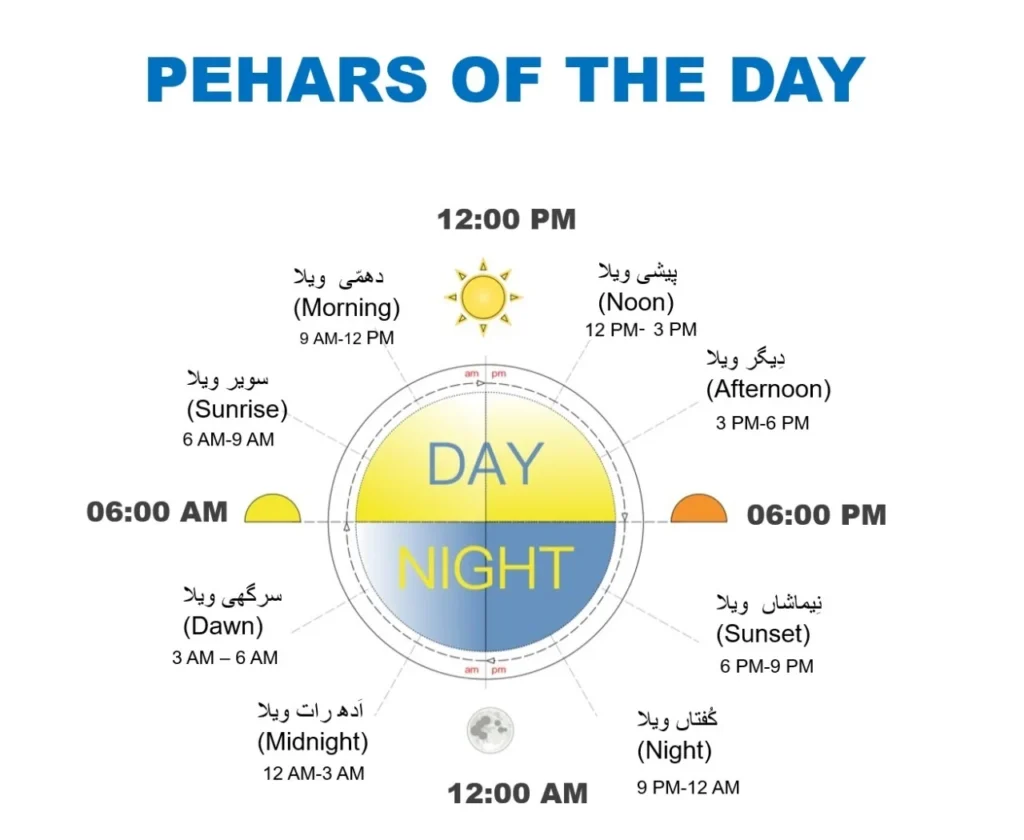
Each month of the Bikrami calendar has some seasonal characteristics and associated festivals. The number of days varies in the 12 months. A month typically falls around 30 to 31 days. A new Punjabi year opens with the month of Chet. A day is divided into eight parts, called “pehars” in the local language. Each pehar is usually three hours long.
| Pehar # | English Name | Punjabi Name | Duration (Bikrami) |
|---|---|---|---|
| Pehar1 | English NameSunrise | Punjabiسویر ویلا | Time6 AM – 9 AM |
| Pehar2 | English NameMorning | Punjabiدھمّی ویلا | Time9 AM – 12 PM |
| Pehar3 | English NameNoon | Punjabiپیشی ویلا | Time12 PM – 3 PM |
| Pehar4 | English NameAfternoon | Punjabiدِیگر ویلا | Time3 PM – 6 PM |
| Pehar5 | English NameSunset | Punjabiنِیماشاں ویلا | Time6 PM – 9 PM |
| Pehar6 | English NameNight | Punjabiکُفتاں ویلا | Time9 PM – 12 AM |
| Pehar7 | English NameMidnight | Punjabiاَدھ رات ویلا | Time12 AM – 3 AM |
| Pehar8 | English NameDawn | Punjabiسرگھی ویلا | Time3 AM – 6 AM |
The table above will be helpful to understand the pehars of a desi day. The division of these pehars is according to the days of the Bikrami Calendar. Names of pehars are mentioned both in English and the Urdu language along with duration. Similarly, the desi month names have been mentioned below in different languages.
Desi Months Names
| Punjabi Month Names (English, Urdu & Gurmukhi) | |||
|---|---|---|---|
| Sr.# | Punjabi Names | Urdu Names | Gurmukhi Names |
| No.1 | English NameChet | Urdu Nameچیت | Gurmukhiਚੇਤ |
| No.2 | English NameVaisakh | Urdu Nameبیساکھ | Gurmukhiਵੈਸਾਖ |
| No.3 | English NameJeth | Urdu Nameجیٹھ | Gurmukhiਜੇਠ |
| No.4 | English NameHarh | Urdu Nameہاڑ | Gurmukhiਹਾੜ੍ਹ |
| No.5 | English NameSawan | Urdu Nameساون | Gurmukhiਸਾਵਣ |
| No.6 | English NameBhadon | Urdu Nameبھادوں | Gurmukhiਭਾਦੋ |
| No.7 | English NameAssu | Urdu Nameاسو | Gurmukhiਅੱਸੂ |
| No.8 | English NameKatak | Urdu Nameکاتک | Gurmukhiਕੱਤਕ |
| No.9 | English NameMaghar | Urdu Nameمگھر | Gurmukhiਮੱਘਰ |
| No.10 | English NamePoh | Urdu Nameپوہ | Gurmukhiਪੋਹ |
| No.11 | EnglishMagh | Urduماگھ | Gurmukhiਮਾਘ |
| No.12 | EnglishPhagun | Urduپھاگن | Gurmukhiਫੱਗਣ |
Getting to Know the 12 Desi Months
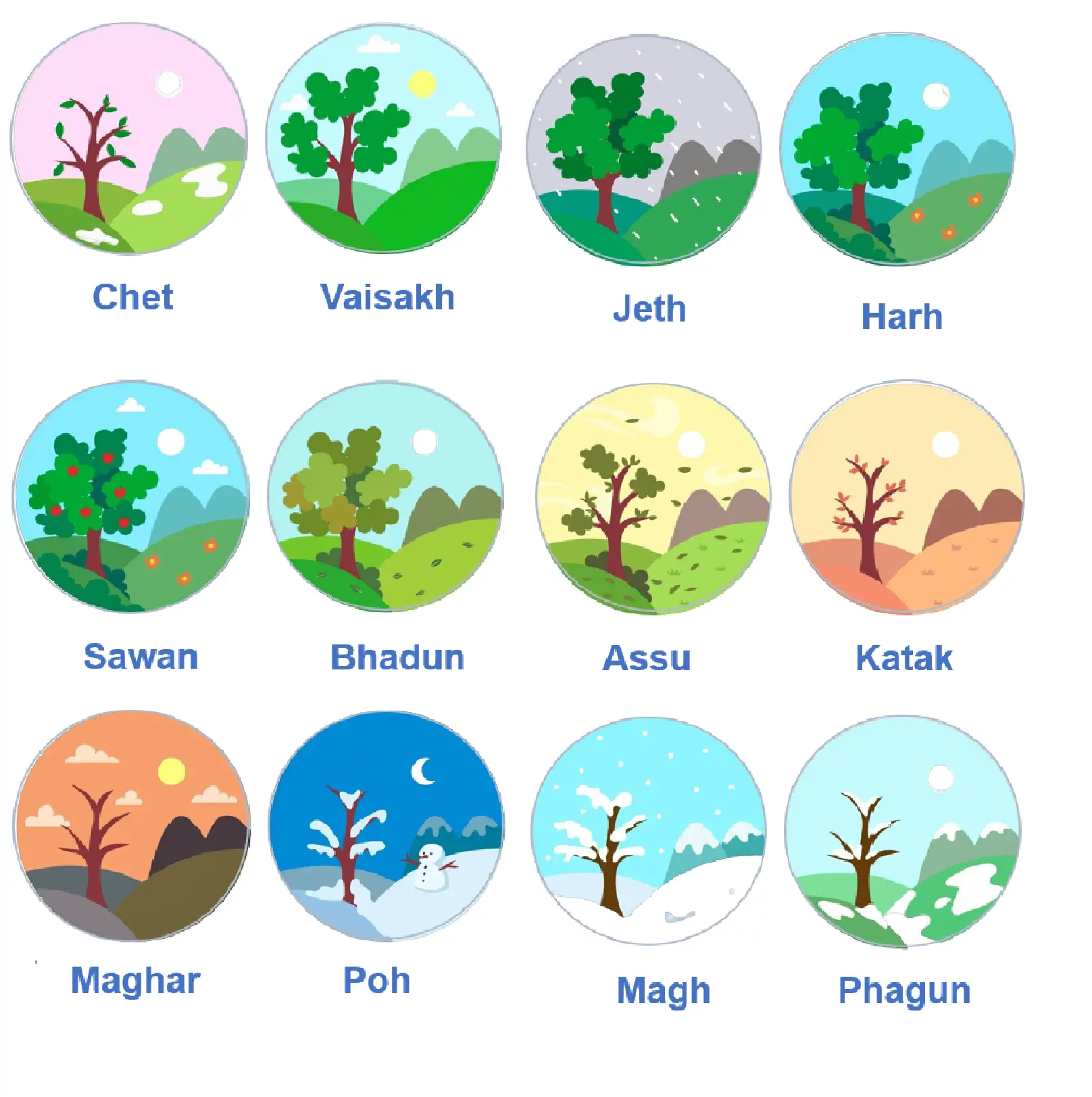
Each desi month has its own unique character and is connected to the seasons of Punjab. Here’s a simple guide to what each month feels like:
- Chet (March – April): The first month and the start of spring. The weather gets warmer, and new flowers and leaves begin to appear.
- Vaisakh (April – May): The weather gets hotter, and it’s a very important time for farmers as they harvest the winter wheat crop. The famous festival of Vaisakhi is celebrated this month.
- Jeth (May – June): This is one of the hottest months in Punjab. The sun is strong, and the days are very long.
- Harh (June – July): The peak of summer continues. This is when the monsoon season usually begins to arrive, bringing the first rains.
- Sawan (July – August): The heart of the monsoon season. It rains a lot, bringing relief from the heat and making everything green.
- Bhadun (August – September): The rainy season continues, and the weather is very humid. It’s a time of lush growth for plants.
- Assu (September – October): The monsoon starts to end, and the weather becomes milder. The days are pleasant, and autumn begins to set in.
- Katak (October – November): A very pleasant month with cool and comfortable weather. It’s a time for many major festivals, including Diwali.
- Maghar (November – December): The start of winter. The weather gets cooler, and the days become noticeably shorter.
- Poh (December–January): This is the coldest month of the year in Punjab. The nights can be very chilly, and you might see fog in the mornings.
- Magh (January – February): It is still very cold, but this month signals that spring is on its way. You can start to see the first signs of new life in plants.
- Phagun (February – March): The last month of the desi year. Winter fades away, and the weather becomes beautiful again as spring returns. It’s a month of colourful flowers and the festival of Holi.
Each week of a desi month contains seven days like the Gregorian month, but the names of these days vary in different languages. These desi days’ names have been mentioned below in the table.
Desi Months Days
| Sr.# | English Names | Urdu Names | Punjabi/Hindi Names |
|---|---|---|---|
| No.1. | English NameMonday | Urdu Nameسوموار | Hindiसोमवार (somavaar) |
| No.2. | English NameTuesday | Urdu Nameمنگل | Hindiमंगलवार (mangalavaar) |
| No.3. | English NameWednesday | Urdu Nameبدھ | Hindiबुधवार (budhavaar) |
| No.4. | English NameThursday | Urdu Nameجمعرات | Hindiगुरुवार (guruvaar) |
| No.5. | English NameFriday | Urdu Nameجمعہ | Hindiशुक्रवार (shukravaar) |
| No.6. | English NameSaturday | Urdu Nameہفتہ | Hindiशनिवार (shanivaar) |
| No.7. | English NameSunday | Urdu Nameاتوار | Hindiरविवार (ravivaar) |
No.of Days and Dates
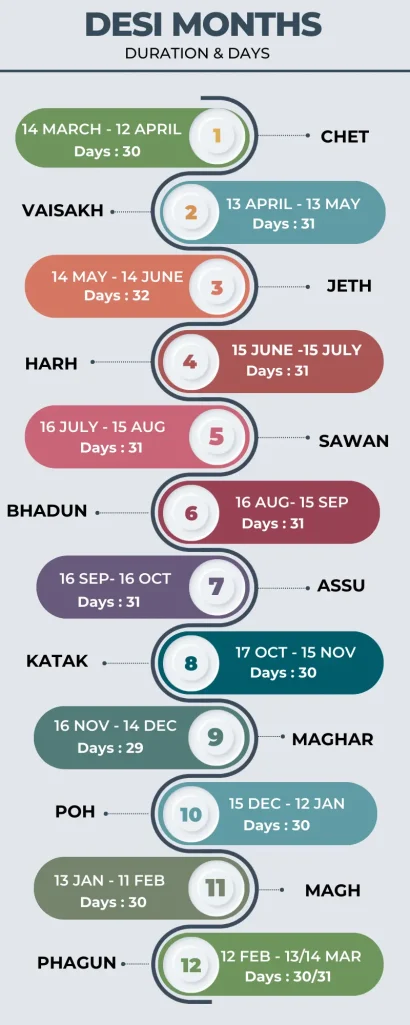
Just like the Gregorian calendar, the Desi calendar is made up of 12 unique months, each with its own duration and name. This visual chart shows the Desi calendar, which has 12 months, just like the regular calendar we use. Each month has its own name and runs from one date to another. It also shows how many days are in each month.
It helps people see which Desi month matches with the months we use every day, like March or April. This is useful for learning about special days, farming times, or family traditions. The colors and dates make it easy to follow. People still use the Desi calendar in many villages and towns for daily life. It is a helpful tool that keeps old ways connected with today’s world.
Save the picture on your phone or show it to a friend, so everyone can remember the Desi dates with ease. A quick share keeps our old calendar alive for the next generation. Let’s keep these special days shining bright!
Significant Days of Desi Months
Beyond the day-to-day dates, the Desi calendar is marked by special days that hold deep cultural and spiritual meaning. These recurring days—Sangrand, Gurpurab, Puranmashi, Masya, Panchami, and Dashmi—form the rhythm of the year’s festivals and observances. Let’s explore what each of these significant days means.
Sangrand – The Month’s First Day
The very first day of each new Desi month is known as Sangrand. It is a special time for reflection, prayer, and welcoming new beginnings. To see a complete list of all 12 dates and learn more about its traditions, please visit our detailed guide.
→ View the full Sangrand Dates 2025 Calendar
Gurpurabs – Festivals of the Gurus
Gurpurabs are the most sacred days in the Sikh faith, marking the birthdays or martyrdoms of the Sikh Gurus. These are important times for the community to gather for prayer, Kirtan, and celebration. Our complete guide lists every major Gurpurab for the year.
→ View the full Gurpurab Dates 2025 Calendar
Puranmashi – The Full Moon
Puranmashi marks the night of the bright, full moon. It is considered a highly auspicious time for many festivals and spiritual practices. You can discover the date for every full moon of the year on our dedicated Puranmashi page.
→ View the full Puranmashi Dates 2025 Calendar
Masya – The New Moon
Masya, or Amavasya, is the night of the new moon when the sky is at its darkest. This is a powerful time for quiet reflection and honoring one’s ancestors. To keep track of these quiet, spiritual days, you can use our complete list.
→ View the full Masya Dates 2025 Calendar
Panchami – The Lucky 5th Day
The fifth day of each lunar fortnight, Panchami, is considered a very lucky day for starting new ventures and for major festivals like Basant Panchami. Find out the dates for every Panchami to plan your auspicious events.
→ View the full Panchami Dates 2025 Calendar
Dashmi – The Victorious 10th Day
The tenth day, Dashmi, carries an energy of victory and success. It is most famously celebrated as Dussehra, which marks the triumph of good over evil. See our list for every Dashmi of the year.
Conclusion
In conclusion, the desi calendar has become essential to some people’s lives in South Asia. It helps people to know what the Desi Month Date Today is, and also guides farmers in their agricultural practices and plays an important role in festivals and religious events of different communities. Whether for planning crops or celebrating festivals, the desi calendar continues to guide and connect people to their roots.
FAQs
Methodology & Sources
- Data basis: Standard panchang/ephemeris calculations with regional adjustments.
- Punjabi (Desi): We reference Nanakshahi (NS) and Bikram Samvat (BS); differences are noted on festival pages.
- Islamic (Hijri): Local sighting for PK/IN when available; otherwise widely used calculations.
- Updates: Daily highlights every morning; fixed 2025 tables reviewed monthly.
- Corrections: Found an issue? Contact us and we’ll review promptly.
Quick links: Puranmashi 2025 · Masya 2025 · Hindu Festivals 2025